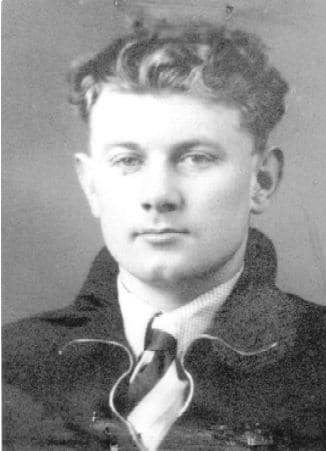
Jan Bonekamp was born in IJmuiden on 19 May 1914. Before the Second World War he lived a fairly ordinary life. He worked as a driver at the Hoogovens steelworks and was active in the transport workers’ union. He was also involved with the Communist Party of the Netherlands. He married Catherina Wilhelmina van den Brink in 1938, and in 1940 the couple had a daughter. Nothing suggested he would later become one of the more daring members of the Dutch resistance.
When the April–May strikes of 1943 broke out, Bonekamp played a small but important part at the Hoogovens plant. He helped spread illegal newspapers and calls to strike. After the strike he was arrested and questioned, but was mistakenly released when the Germans believed they had the wrong “Bonekamp.” Once he realised they were still after him, he hid beneath the floor of his own home until he could flee. He spent some time in hiding in Brabant and later joined groups involved in armed resistance.
One of the most feared collaborators in the Zaan region was police chief Willem Ragut. He actively hunted down resistance members, which led the Raad van Verzet (RVV) to decide that he had to be eliminated. Bonekamp and Hannie Schaft received the assignment.
Bonekamp, often called “Kleine Jan,” prepared the attack carefully. On 21 June 1944, he and Schaft waited for Ragut on the Westzijde in Zaandam. When Ragut approached, Schaft fired first and quickly rode away on her bicycle. Bonekamp moved in to finish the job, but Ragut managed to fire back and shot him in the stomach. Bonekamp emptied his weapon at Ragut, who died on the spot. The gunfire was mostly drowned out by a passing formation of bombers.
Schaft escaped safely, but Bonekamp, badly wounded, staggered away and sought help. Two elderly women called the police, who then alerted the Sicherheitsdienst. Bonekamp was taken to the Wilhelmina Gasthuis in Amsterdam under heavy guard.
At the hospital, the Germans tried to force information from him. They injected him with drugs and questioned him intensely. Under pressure, he gave up the address of his wife and possibly others connected to the resistance. Several conflicting stories exist about his final moments. Some say a German officer pretended to be a friend to persuade him to talk; another story says a resistance nurse encouraged him to pass on information she could warn others about. In any case, he eventually mentioned Hannie Schaft’s name and address, which contributed to her later arrest.
Bonekamp died shortly afterward from his wounds. A resistance group had been preparing a plan to rescue him from the hospital, but it was too late.
A week after liberation, on 12 May 1945, a monument for Jan Bonekamp was placed in the garden of the Chamber of Commerce in Zaandam. Streets in Zaandam and IJmuiden were later named after him, and in 1980 a memorial stone was added at the site of the gunfight where he was fatally wounded.
Bonekamp was buried at the Westerbegraafplaats in IJmuiden. In the early 1980s, some former resistance members tried to have his remains re-interred at the Eerebegraafplaats in Bloemendaal, but the request was denied because the cemetery had already been officially closed.
In 2004 his grave was rediscovered and received a new headstone. Since then, a local committee has organised an annual remembrance ceremony every 4 May. One of the regular attendees for many years was resistance member Freddie Oversteegen.