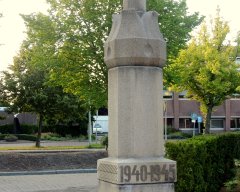
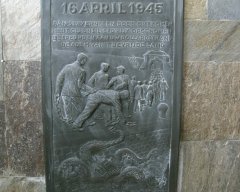
The Bevrijdingsplaquettes (liberation plaques) in Appingedam pay tribute to the Canadian 'Royal Winnipeg Rifle Regiment,' which liberated the city on April 23, 1945.
In early April 1945, the Allies rapidly advanced towards Groningen province, liberating it in three regions: the border area between Musselkanaal and the Dollard, the city of Groningen, and the 'bridgehead Delfzijl.' On April 11, the First Polish Armored Division crossed into the province, followed by the Canadian Infantry Division led by General A.B. Matthews, which liberated Groningen between April 13 and 16, 1945.
Appingedam, surrounded by floods, was liberated on April 23, 1945, by the Canadian 'Royal Winnipeg Rifle Regiment.' Street fighting and artillery duels took place, but the German defense, mainly naval personnel, couldn't withstand the Canadian infantry. Over a hundred Germans surrendered, marking the liberation of Appingedam.
On the memorial plaque of the 'Royal Winnipeg Rifle Regiment,' there is an erroneous mention that the A Company captured coastal artillery at Delfzijl. However, after being relieved by the 'British Columbia Dragoons,' the 'Winnipeg Rifles' were deployed in the Carel Coenraadpolder, where they captured the 'Dollart-Süd' battery.
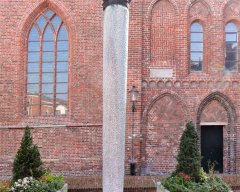
The liberation plaques are attached to the exterior wall of the N.H. Church on Wijkstraat in Appingedam.