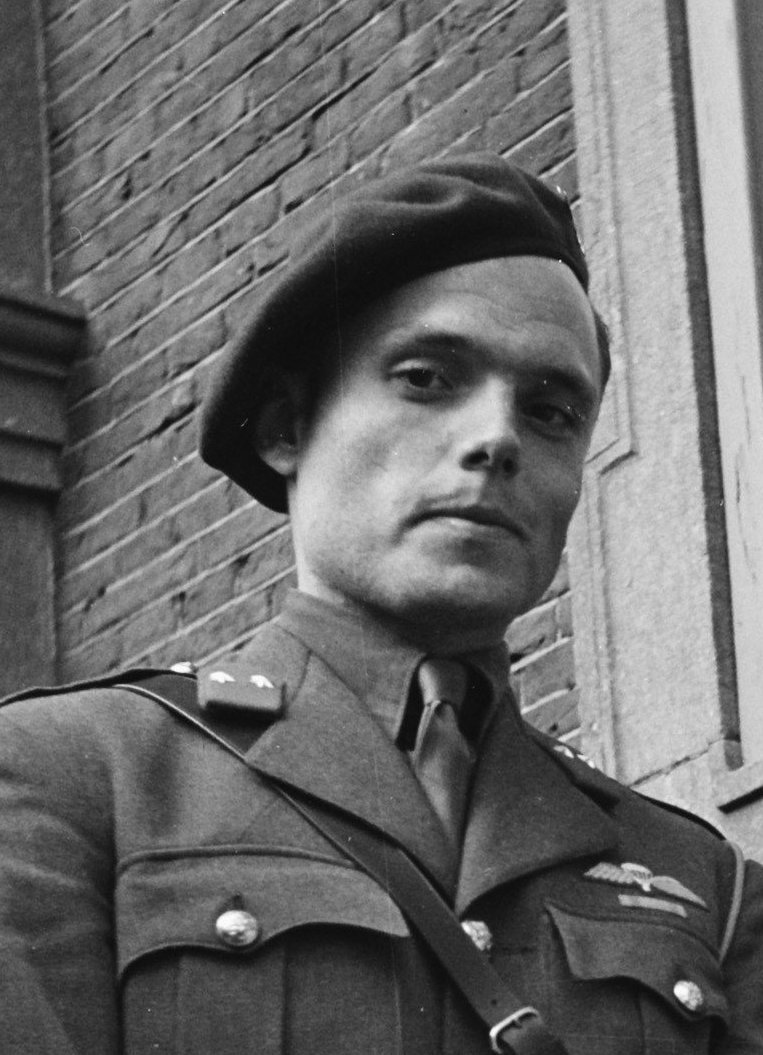
Peter Tazelaar was a member of the Dutch resistance during the Second World War and later worked as an agent for the British Special Operations Executive (SOE). He is best known for his role in Operation Contact Holland and his daring landing at Scheveningen while disguised in a tuxedo. After the war, Tazelaar continued a secretive and adventurous career in military and intelligence service. His activities during and after the war are often mentioned as one of the inspirations for Ian Fleming’s James Bond series.
Tazelaar began his military training in September 1938 as a midshipman at the Royal Netherlands Naval College. In 1939 he moved to Groningen, where he enrolled at the Hogere Zeevaartschool. When Germany invaded the Netherlands on 10 May 1940, he was serving in the Dutch Merchant Navy. Shortly after the invasion, he attempted to escape to England via Zeeland and northern France, but the attempt failed and he returned to Groningen.
Back in Groningen, Tazelaar came into contact with fellow midshipman Johan Birnie. During the summer of 1940, Birnie had joined a resistance group formed by cadets and midshipmen known as the Ordedienst. Through Birnie, Tazelaar was introduced to the organisation in The Hague, which was led by the Dutch nobleman Joan Schimmelpenninck, who used the codename “Uncle Alexander”.
Because the resistance had no direct contact with England, Tazelaar was chosen to make the dangerous journey there. In early June 1941, he signed on as a stoker aboard the Panamanian-flagged Swiss freighter St-Cergue, which was docked in Schiedam and officially bound for New York. On board were several other escapees, including Bram van der Stok and Erik Hazelhoff Roelfzema. Near the Faroe Islands, they transferred to a British cruiser and were able to reach England.
In England, contact with occupied Netherlands proved difficult at first. Eventually, Tazelaar and his companions came into contact with Queen Wilhelmina and Prince Bernhard and were even allowed to live in an apartment at the Queen’s residence. A plan was developed to land agents on the Dutch coast by boat under the name Contact Holland. Peter Tazelaar became the first agent to be sent back.
On 23 November 1941, Tazelaar was landed near the pier at Scheveningen. Dressed in a tuxedo, he posed as a drunken partygoer returning from the casino and managed to pass German guards on the beach. Despite the successful landing, the mission ran into serious problems when the radio equipment was damaged, preventing reliable contact with England. A second assignment, involving the transport of important individuals to England, also failed. After several arrests by German forces, it became too dangerous for Tazelaar to remain in the Netherlands.
In January 1942, he escaped together with midshipman Gerard Dogger via Switzerland, traveling through France, Spain and Portugal before reaching England again in April 1942. Tazelaar warned his superiors that the operation may have been compromised by German intelligence, but his warnings were ignored. After the war, it became clear that many agents had indeed been arrested.
After further training in Wales, Tazelaar served as an instructor in Canada and later returned to England. On 9 September 1944, he was awarded the Military Order of William, the highest Dutch military decoration, for his bravery and role in Operation Contact Holland. He later joined the Bureau of Special Operations and in November 1944 was parachuted into Friesland together with Lykele Faber, where they maintained radio contact with England for six months.
In April 1945, Tazelaar was appointed aide-de-camp to Queen Wilhelmina and accompanied her on her return to the Netherlands. He was the officer who informed her of the German surrender. Film footage from the period shows him standing next to Erik Hazelhoff Roelfzema at Gilze-Rijen Air Base.
After the war in Europe, Tazelaar volunteered for service in Asia and traveled to Ceylon before going to the Dutch East Indies, where his mother had been interned by the Japanese in the Tjideng camp on Java. He joined the military police and was involved in security operations during the Indonesian conflict. In March 1946, he was wounded and returned to the Netherlands.
In later years, Tazelaar continued to live an adventurous life. During the Cold War, he worked behind the Iron Curtain in Eastern Europe for the United States, reportedly for the CIA. He later worked for companies such as KLM and Shell and married four times. Tazelaar became more widely known after the publication of Soldier of Orange and the 1977 film adaptation.
Peter Tazelaar died on 6 June 1993 in Hindeloopen. A memorial in his honor was unveiled there in 2014, remembering a man whose life combined resistance, espionage and postwar intelligence work in an exceptional way.