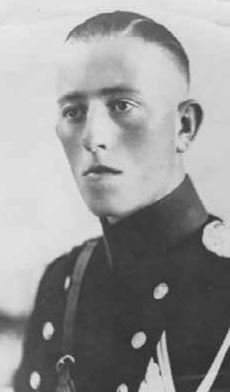
Dirk de Ruiter was born on 24 October 1920 at Dwarsweg 129a (today Dwarsweg 1) in Nijensleek, Drenthe, Netherlands. He was one of eight children of Minne de Ruiter and Geertje de Boer, though two of his siblings died young. Dirk grew up in a rural environment and worked as a farmhand, showing from an early age a quiet determination and strong sense of justice. He became engaged to Jannie Potze from Sellingen, though the exact date of their engagement is unknown.
In February 1940, Dirk was called up as a conscript for the 19th Infantry Regiment Depot. After the Dutch capitulation, he was demobilized and, on 14 October 1940, joined the marechaussee (Dutch military police) on foot, initially stationed in the Groninger border region at Sellingen and later in Nieuweschans. Despite his reserved and modest nature, Dirk’s integrity and courage became evident as he quietly assisted those in need, including prisoners at Westerbork transit camp, providing food and aid to detainees. His actions were discovered, and on 17 November 1942, he was dismissed for aiding Jews (judenbegünstigung).
In February 1943, through the intervention of the mayor of Onstwedde, Dirk secured work as a distributions officer in Stadskanaal, where he began to actively help people in hiding. He distributed ration cards, false identity papers, and illegal newspapers. By the fall of 1943, Dirk was fully involved in the resistance. When called up for the Arbeitseinsatz in Germany in April 1944, he went into hiding and worked full-time for the underground.
Dirk’s bravery was shown in two deadly confrontations with collaborators. On 16 June 1944, during a raid on the house of Luuk Riensema in Musselkanaal, Dirk shot a WA leader, Buursma, and escaped, though his actions provoked severe reprisals against his family. Later, on 12 July 1944, during a search by the Landwacht in Horsten, Dirk was severely wounded after shooting at an attacking patrol. Despite efforts to get him to safety, he died from his injuries in Mussel, Drenthe, at the age of 23.
His body was taken to the Sicherheitsdienst in Groningen and cremated in Velzen. After the liberation, Dirk’s urn was recovered, and a memorial service was held on 3 September 1945. In 1986, his urn was buried at the Vledder cemetery, and in 1994, a connecting path between Vaartweg in Wilhelminaoord and the Dwarsweg was named Dirk de Ruiterpad in his honor.
On 11 April 2025, a steel names monument was unveiled in Stadskanaal, at the local resistance monument in Julianapark, commemorating Dirk and other heroes of the resistance.
Dirk de Ruiter is remembered as a quiet yet courageous man, who stood firmly against Nazi occupiers and their collaborators, sacrificing his life to protect his fellow citizens and uphold justice. His story remains a lasting tribute to the bravery and resilience of the Dutch resistance during the Second World War.