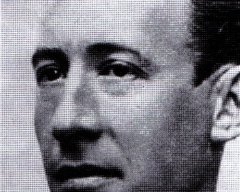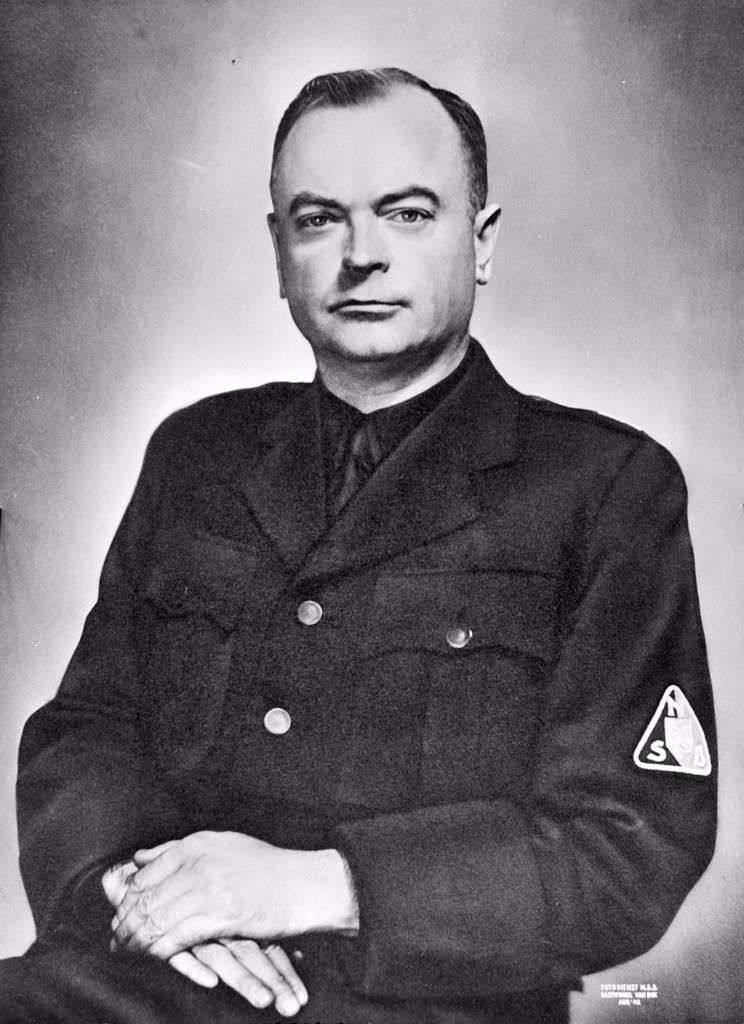
Anton Adriaan “Ad” Mussert was born on 11 May 1894 in Werkendam, the son of headteacher Johannes Leonardus Mussert and Frederika Witlam. He grew up in a household marked by contrasts: his father was outwardly respected and helpful, but strict and often harsh at home, while his mother was known for her snobbish airs. These tensions made for a turbulent family life, though Anton received a solid education.
As a student, Mussert excelled in technical subjects such as physics and mathematics but consistently underperformed in German language and literature — ironic, given his later political choices. After the sudden death of his father in 1913, his studies briefly suffered, but with guidance he recovered and went on to train as a civil engineer at the Technical College in Delft.
Mussert briefly served in the Dutch army at the start of the First World War, but illness forced his release. Returning to civilian life, he built a career with Rijkswaterstaat and later the Provincial Water Authority in Utrecht, where he rose to chief engineer. By all accounts, he was talented in his field and respected as a professional.
In 1931, his career took a radical turn. Angered by Dutch support for a waterway project connecting Antwerp with the Rhine — which he saw as a betrayal of national interests — Mussert co-founded the Nationaal-Socialistische Beweging (NSB) with Cornelis van Geelkerken. The NSB quickly adopted fascist and later Nazi-inspired ideas. Within the movement, Mussert proved a charismatic speaker and soon became its undisputed leader, modeled after Mussolini and Hitler. He allowed himself to be called “the Leader,” and within NSB circles a cult of personality grew around him.
Despite this, the NSB never gained mass support. In the 1937 parliamentary elections it achieved just over 4 percent of the national vote, and in later elections even less. In deeply religious towns such as Werkendam, resistance to the NSB was strong, particularly from the Reformed Church. Nationally, the party remained marginal, though its rhetoric grew more extreme and anti-Semitic as the war approached.
During the German occupation of the Netherlands, Mussert aligned fully with Nazi Germany. He met Heinrich Himmler in 1941 and later swore allegiance to Hitler in Berlin, declaring loyalty “to death.” He supported discriminatory policies, sent Dutch volunteers to fight with the Waffen-SS on the Eastern Front, and profited directly from the dispossession of Jewish families. Though he was not the architect of deportations, he benefited from confiscated property, newspapers, and businesses, becoming a wealthy man while others suffered.
After the liberation in 1945, Mussert was arrested, tried for high treason, and condemned to death. On 7 May 1946, just four days before his 52nd birthday, he was executed on the Waalsdorpervlakte near The Hague, a site where many Dutch resistance members had been killed during the war. His body was buried anonymously in a mass grave at The Hague’s general cemetery, its exact location left uncertain to prevent his grave from becoming a place of pilgrimage.
Mussert’s life is a cautionary tale of how a respected civil servant and engineer transformed into a collaborator and traitor. He remains one of the most infamous figures in Dutch history — remembered less for his talents than for the choices that led him to betray his country in its darkest years.