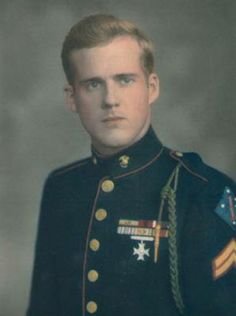
Eugene Bondurant Sledge remains one of the most compelling wartime witnesses of the Pacific campaign. Not a career military man by original design, he became a Marine out of conviction, then a scientist and professor out of the need to rebuild a life touched deeply by war. His writings stand today as an essential record, especially for those of us who study history at the ground level, where human experience matters more than grand strategy.
Sledge was born in Mobile, Alabama, into a family that valued public duty and education. His father, Dr. Edward Simmons Sledge, was a physician well known in the community. His mother, Mary Frank Sturdivant Sledge, worked in higher education and served as dean of women students at Huntingdon College. The Sledges lived at Georgia Cottage starting in 1935, a home that would later be mentioned often in accounts of Eugene’s early years.
His older brother, Edward S. Sledge II, had already stepped forward to serve when war came. A graduate of The Citadel, Edward II was commissioned in the U.S. Army and fought across the Western Front, including the landings at Omaha Beach and later the Battle of the Bulge. He earned multiple decorations for wounds and valor, including three Purple Hearts, Bronze Stars, and the Silver Star, before leaving the service as a Major. Amateur historians sometimes overlook him in favor of Eugene’s Pacific stories, but it is impossible to study one Sledge brother without acknowledging the courage of the other.
Eugene’s path was less straightforward. As a young child, he suffered from rheumatic fever, which kept him out of school for long stretches and left him with a permanent heart murmur. Because of this, his family deeply feared for his safety, especially as the war intensified around brutal island battles. His lifelong friend Sidney Phillips, fighting at Guadalcanal, even wrote letters pleading with him not to enlist. History would show they had reason to worry: the Pacific would demand everything from those sent to fight there.
Still, Sledge could not stay behind. He briefly attended the Marion Military Institute, beginning officer training before choosing instead to enlist as a private in the Marine Corps in December of 1942. Later accepted into the V12 officer program at Georgia Tech, he and many of his detachment intentionally failed out, choosing to be deployed as standard enlisted Marines rather than “miss the war.” This fact alone tells you much about the mindset of young men in 1942 – anxious not for safety, but for purpose.
Sledge joined K Company, 3rd Battalion, 5th Marines, 1st Marine Division, serving primarily as a 60 mm mortarman. He landed at Peleliu in 1944, where combat devolved into exhaustion, closequarters horror, and massive casualties. In 1945, he fought again at Okinawa, one of the final and deadliest battles of the Pacific war. When mortar fire was no longer practical, he served where needed – carrying stretchers, ammunition, or a rifle. Unlike many veterans who later wrote about the war from memory alone, Sledge took notes in real time, scribbled into his small New Testament. These battlefield observations became the foundation for his later memoir.
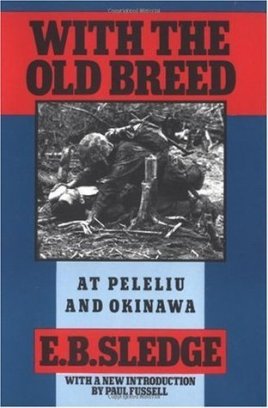
In 1981, Sledge published With the Old Breed: At Peleliu and Okinawa, a book respected for its blunt truth, lack of exaggeration, and strong sense of shared human hardship. Years later, it was used as source material for the PBS documentary The War and HBO’s dramatization The Pacific, where actor Joseph Mazzello portrayed him in service. But long before Hollywood, historians admired the book because it felt like a field notebook more than a polished memoir – observant, subjective, imperfect in neatness, but perfect in honesty.
After the war, Sledge was posted for a time in China before returning home. He discharged from the Marines in February 1946 as a corporal. Coming home was its own battle. Sledge struggled greatly with the sudden quiet of civilian life, especially when surrounded by those who could not imagine the scale of loss or devastation he had seen. He gave up hunting after realizing he could no longer tolerate witnessing suffering, even in animals. One of the most repeated stories among veterans is the dove hunt that left him in tears after mercy killing a wounded bird. That moment is important to remember, because it marked the beginning of his transition from destroyer of enemies to observer of nature.
Sledge enrolled at Auburn University. There, his career took shape in unexpected ways – business studies first, then botany, then biology. He earned his master’s degree in 1955 and completed his doctorate at the University of Florida in 1960. His specialty included parasitology research, especially helminthology, the study of parasitic worms. It is an oddly poetic twist for a man who once lived in mud and combat trenches to later study lifeforms invisible to most people.
By 1962, Sledge returned to Alabama as an assistant professor of biology at Alabama College (now the University of Montevallo). Over the decades he taught zoology, bird science (ornithology), and vertebrate anatomy. He was well liked, known for taking students into the field to observe nature directly rather than simply reading about it in textbooks.
Sledge married Jeanne Arceneaux in 1952. They raised two sons, John and Henry. His son Henry later became a military historian himself, working to expand and preserve his father’s legacy. In 2025, Henry published a book documenting the generational impact of the war on their family, emphasizing that history is not just events – it is inheritance.
Eugene Bondurant Sledge passed away in 2001 from stomach cancer. He was buried in Pine Crest Cemetery in Mobile, Alabama.
For amateur historians, Sledge remains one of our most important voices. He reminds us that the Pacific War was not only a sequence of battles, but a human ordeal. He wrote not as a polished author trying to impress, but as someone taking testimony seriously, preserving memory for those lost. That is exactly why his work continues to matter on history websites, archives, and databases around the world.